By Brian Cooley
Editor at large
May 9, 2005
"Voice recognition. Does the idea of talking cars make you think the Enterprise's computer on the original Star Trek series? As we see more layers of interface added to cars, voice recognition will be a necessary tool to keep drivers' eyes on the road. Presently, only high-end cars sport voice recognition, but working-class stiffs don't have more eyes than rich folks--everyone deserves this technology."
Voice recognition systems may well be a practical technology worth implementing to the presentation piece. As the article highlights it is important for users to keep an eye on the road and to be able to have the option to accept invites from the NavSystem without taking their hands of the wheel. Although when you think about car drivers critically is it any different accepting the invite be pressing a button than it is fiddling with the radio or playing with your phone?
Showing posts with label Background Research. Show all posts
Showing posts with label Background Research. Show all posts
Tuesday, 12 December 2006

Persona Based Marketing
By M. H. "Mac" McIntosh, CBC
Meet Bill, he's the owner and CEO of a growing, mid-sized manufacturing company. Bill is in his early 40s, wears glasses and tries his best to squeeze in an early-morning workout whenever he can. He prefers to wear golf shirts and khakis, donning a suit only when he has to. Bill drives a late model SUV with a booster seat in the back seat for his four-year-old daughter. He's harried, and worries about managing his company's growth. He wants to leverage technology to increase operational efficiency and customer satisfaction, and to offset the rising costs of doing business, but doesn't know where to start.
Helen is his director of sales. She's 32, single, a competitive runner, and is partial to 80s rock. She drives a new BMW convertible. She struggles with managing a dozen salespeople, many who are 10 to 15 years older then her. Helen wants the company to invest in a new CRM system to replace the contact management they long ago outgrew, but wonders how she'll convince Bill and the company's CFO to spend the money.
Bill and Helen are not real people, but they're examples of one of the most powerful tools you can use to better connect with prospects and customers: persona-based marketing.
Persona-based marketing is part Hollywood characterization and part business analytics. It involves constructing a fictional customer-based on real-life data and intelligence-and then using that character as the touchstone for promotional and selling decisions.
The concept of persona based marketing is extremely interesting and can be directly applied to my Heritage Week event proposals. The primary purpose of the use of mobile devices within the event is to educate inform and interact with the consumer to enhance their visit and place into context what they see. However, like all commercial ventures, revenue must be generated to pay for the initial investment and ensure it can continue once the event has ended.
This model of persona based marketing should be considered when targeting consumers with advertisements through their mobile devices. I need to cater for as many theoretical personalities as possible. For example a family with young children may want to purchase toys for the children, in stark contrast to a middle aged single man who may be interested in something with more substance, such as a book or tour guide. Similarly consumers may wish to utilise services that are not integral to the scheme but can still generate revenue for the Heritage Area site. For example the use of coffee shops within the site.
Meet Bill, he's the owner and CEO of a growing, mid-sized manufacturing company. Bill is in his early 40s, wears glasses and tries his best to squeeze in an early-morning workout whenever he can. He prefers to wear golf shirts and khakis, donning a suit only when he has to. Bill drives a late model SUV with a booster seat in the back seat for his four-year-old daughter. He's harried, and worries about managing his company's growth. He wants to leverage technology to increase operational efficiency and customer satisfaction, and to offset the rising costs of doing business, but doesn't know where to start.
Helen is his director of sales. She's 32, single, a competitive runner, and is partial to 80s rock. She drives a new BMW convertible. She struggles with managing a dozen salespeople, many who are 10 to 15 years older then her. Helen wants the company to invest in a new CRM system to replace the contact management they long ago outgrew, but wonders how she'll convince Bill and the company's CFO to spend the money.
Bill and Helen are not real people, but they're examples of one of the most powerful tools you can use to better connect with prospects and customers: persona-based marketing.
Persona-based marketing is part Hollywood characterization and part business analytics. It involves constructing a fictional customer-based on real-life data and intelligence-and then using that character as the touchstone for promotional and selling decisions.
The concept of persona based marketing is extremely interesting and can be directly applied to my Heritage Week event proposals. The primary purpose of the use of mobile devices within the event is to educate inform and interact with the consumer to enhance their visit and place into context what they see. However, like all commercial ventures, revenue must be generated to pay for the initial investment and ensure it can continue once the event has ended.
This model of persona based marketing should be considered when targeting consumers with advertisements through their mobile devices. I need to cater for as many theoretical personalities as possible. For example a family with young children may want to purchase toys for the children, in stark contrast to a middle aged single man who may be interested in something with more substance, such as a book or tour guide. Similarly consumers may wish to utilise services that are not integral to the scheme but can still generate revenue for the Heritage Area site. For example the use of coffee shops within the site.
Semacodes
Semacode is a software company based in Waterloo, Ontario, Canada. It is also this company's trade name for machine-readable ISO/IEC 16022 Data Matrix symbols which encode internet Uniform Resource Locators (URLs). It is primarily aimed at being used with cellular phones which have built-in cameras. The Data Matrix specification is given by the ISO/IEC 16022 standard.
Semacoding could be extremely useful within my campaign, allowing users to interact with the objects they encounter at Heritage Areas and given them a broder knowledge of what’s around them on their visit.
Using Semacode SDK software, a URL can be converted into a type of barcode resembling a crossword puzzle, which is called a "tag". Tags can be quickly captured with a mobile phone's camera and decoded to obtain a Web site address. This address can then be accessed via the phone's web browser.
Semacodes could be used to link to websites relevant to specific objects or to utilise search engine technology to provide users with a list of resources to choose from as opposed to directing them to one resource alone.
The Semacode website states that Semacode tags are an "open system" and that tag creation is "completely unrestricted," with the SDK software tools being free of charge for non-commercial use.
It is worth considering that of this where a real venture then it would in some way rely on commercial revenue, therefore it would be necessary to pay a license fee for ht usage of the technology. Also how many consumers will be familiar with the usage of such technology?
Usage Examples:
Potential uses for Semacode tags are still being explored, and will complement development of the concept of using mobile phones as devices for information gathering and exchange. placing Semacode tags on posters, such as those for concerts and public performances. Those interested could use their mobile phone to take a photo of the tag, which could link them directly to the web page where they could order tickets.
Using Semacode tags and mobile phones to enable multilingual museum exhibits - a tag photographed at the exhibition entrance could set a language cookie in the phone's web browser, and subsequent Semacode tags displayed at each exhibit could then link the phone's browser directly to a web page about the item, displayed in the user's language of choice.
Placing Semacode tags on nametags given to conference attendees. These tags could provide the corporate web address of each attendee's company.

Semacoding could be extremely useful within my campaign, allowing users to interact with the objects they encounter at Heritage Areas and given them a broder knowledge of what’s around them on their visit.
Using Semacode SDK software, a URL can be converted into a type of barcode resembling a crossword puzzle, which is called a "tag". Tags can be quickly captured with a mobile phone's camera and decoded to obtain a Web site address. This address can then be accessed via the phone's web browser.
Semacodes could be used to link to websites relevant to specific objects or to utilise search engine technology to provide users with a list of resources to choose from as opposed to directing them to one resource alone.
The Semacode website states that Semacode tags are an "open system" and that tag creation is "completely unrestricted," with the SDK software tools being free of charge for non-commercial use.
It is worth considering that of this where a real venture then it would in some way rely on commercial revenue, therefore it would be necessary to pay a license fee for ht usage of the technology. Also how many consumers will be familiar with the usage of such technology?
Usage Examples:
Potential uses for Semacode tags are still being explored, and will complement development of the concept of using mobile phones as devices for information gathering and exchange. placing Semacode tags on posters, such as those for concerts and public performances. Those interested could use their mobile phone to take a photo of the tag, which could link them directly to the web page where they could order tickets.
Using Semacode tags and mobile phones to enable multilingual museum exhibits - a tag photographed at the exhibition entrance could set a language cookie in the phone's web browser, and subsequent Semacode tags displayed at each exhibit could then link the phone's browser directly to a web page about the item, displayed in the user's language of choice.
Placing Semacode tags on nametags given to conference attendees. These tags could provide the corporate web address of each attendee's company.
Wednesday, 22 November 2006
Mobile "GPRS" Technologies Assist Interactive Campaigns
The following article demonstrates how some of the technologies i have mentioned with regard to promoting both of my event ideas are becoming a reality, and that other company's are considering technologies such as GPRS(SatNav) to create highly interactive campaignes that utilise mobile technologies.
"Mobile 365 today announced a partnership with digital communications pioneer, Hyro. The Mobile 365 and Hyro partnership opens the way for true convergence of Web and mobile, enabling marketers to conduct high-value mobile marketing campaigns that connect with Websites, customer databases, loyalty programs, and ITV applications."
They mention how the convergence of web and mobile is creating new ways for businesses or campaigns to promote themselves. This is relevant to both of my campaign ideas. Firstly in terms of the "Health Awareness Campaign" this convergence of the websites and mobile technologies could make it possible for users to select their shopping online and then receive a critique on their diet direct to their mobile phones.
"With GPRS, MMS, and 3G handsets more widely available, rich media content via the mobile phone is a reality. Mobile 365 assists our customers in delivering highly effective interactive campaigns utilising mobile technologies. Customers and end-users can now experience a new level of interactivity via mobile campaigns that incorporate colour pictures, video, audio, and animation," said Cameron Franks, Mobile 365 Country Manager. "We are very excited about the long term partnership with Hyro. Hyro works with major brands across a variety of sectors, and has the right unique mix of commercial, creative and technical skills to deliver on their wireless strategies."
The "Heritage Week" campaign seems viable when you consider that GPRS and mobile technologies can be combined, and with the added support mentioned for picturea and animation then perhaps it would be possible to have a map on the mobile screen generated by the GPRS with a moving elements to define a consumers location in relation to the spot of interest they are attempting to navigate to. They mention that they work with many major brands, this kind of collaboration could prove beneficial in promoting GPRS and other interactive technologies as standard on consumers mobile phone screens. This in turn can only be beneficial for the success of the "Heritage Week" campaign in the future.
"Mobile 365's platform is a perfect fit for Hyro's cross platform marketing services, enhancing Hyro's ability to deliver a comprehensive set of mobile services ranging from SMS marketing to sophisticated application development and content management for the latest colour screen mobile handsets," said Chris Flintoft, Group Manager, Wireless & Broadcast, Hyro. "As a regional business, Mobile 365's ability to deliver reliable connectivity across our Asian footprint, particularly in Southeast Asia—as well as a suite of world-class 'out of the box' applications—was critical in choosing them to assist us."
They seem to be focusing on the posspossibilities of mobile technologies providing businesses with a new platform for maremarketing and advertising to consumers. They mention the use of SMS marketing, which i had considered as an approach to my "Health Campaign Event." By targeting users with SMS messages critiquing their diet and offering advice.
"Mobile 365's Application Manager Platform helps companies deliver a broad range of multimedia services, including SMS, MMS, video, and WAP. In one simple package, the platform enables access to global markets, advanced financial clearing and settlement, and robust reporting. This makes it easy for customers to create revenue-generating mobile marketing and entertainment campaigns including voting, alerts, interactive and subscription services, live event contests, and more. Mobile 365, previously Mobileway, was the first global player to set up an office in Australia in January 2001."
The development of such platforms for supporting these new services on mobile technologies is crucial to the success of both of my suggested campaings. If the consumers mobile technologies cannot accomodate such interactivity then it will be hard to market such service based interactive campaigns toward them. This article is very encouraging and reiterates the benefits in marketing terms for such technologies and what we can offer consumers via mobile technologies. No longer are we only targetable in our homes via TV, we could effectively be exposed to advertising wherever we go via cross platfrom technologies, that we can essentialy take anywhere with us.
What is Possible with Emerging Technologies: Campaigns and Applications
"Mobile 365 today announced a partnership with digital communications pioneer, Hyro. The Mobile 365 and Hyro partnership opens the way for true convergence of Web and mobile, enabling marketers to conduct high-value mobile marketing campaigns that connect with Websites, customer databases, loyalty programs, and ITV applications."
They mention how the convergence of web and mobile is creating new ways for businesses or campaigns to promote themselves. This is relevant to both of my campaign ideas. Firstly in terms of the "Health Awareness Campaign" this convergence of the websites and mobile technologies could make it possible for users to select their shopping online and then receive a critique on their diet direct to their mobile phones.
"With GPRS, MMS, and 3G handsets more widely available, rich media content via the mobile phone is a reality. Mobile 365 assists our customers in delivering highly effective interactive campaigns utilising mobile technologies. Customers and end-users can now experience a new level of interactivity via mobile campaigns that incorporate colour pictures, video, audio, and animation," said Cameron Franks, Mobile 365 Country Manager. "We are very excited about the long term partnership with Hyro. Hyro works with major brands across a variety of sectors, and has the right unique mix of commercial, creative and technical skills to deliver on their wireless strategies."
The "Heritage Week" campaign seems viable when you consider that GPRS and mobile technologies can be combined, and with the added support mentioned for picturea and animation then perhaps it would be possible to have a map on the mobile screen generated by the GPRS with a moving elements to define a consumers location in relation to the spot of interest they are attempting to navigate to. They mention that they work with many major brands, this kind of collaboration could prove beneficial in promoting GPRS and other interactive technologies as standard on consumers mobile phone screens. This in turn can only be beneficial for the success of the "Heritage Week" campaign in the future.
"Mobile 365's platform is a perfect fit for Hyro's cross platform marketing services, enhancing Hyro's ability to deliver a comprehensive set of mobile services ranging from SMS marketing to sophisticated application development and content management for the latest colour screen mobile handsets," said Chris Flintoft, Group Manager, Wireless & Broadcast, Hyro. "As a regional business, Mobile 365's ability to deliver reliable connectivity across our Asian footprint, particularly in Southeast Asia—as well as a suite of world-class 'out of the box' applications—was critical in choosing them to assist us."
They seem to be focusing on the posspossibilities of mobile technologies providing businesses with a new platform for maremarketing and advertising to consumers. They mention the use of SMS marketing, which i had considered as an approach to my "Health Campaign Event." By targeting users with SMS messages critiquing their diet and offering advice.
"Mobile 365's Application Manager Platform helps companies deliver a broad range of multimedia services, including SMS, MMS, video, and WAP. In one simple package, the platform enables access to global markets, advanced financial clearing and settlement, and robust reporting. This makes it easy for customers to create revenue-generating mobile marketing and entertainment campaigns including voting, alerts, interactive and subscription services, live event contests, and more. Mobile 365, previously Mobileway, was the first global player to set up an office in Australia in January 2001."
The development of such platforms for supporting these new services on mobile technologies is crucial to the success of both of my suggested campaings. If the consumers mobile technologies cannot accomodate such interactivity then it will be hard to market such service based interactive campaigns toward them. This article is very encouraging and reiterates the benefits in marketing terms for such technologies and what we can offer consumers via mobile technologies. No longer are we only targetable in our homes via TV, we could effectively be exposed to advertising wherever we go via cross platfrom technologies, that we can essentialy take anywhere with us.
What is Possible with Emerging Technologies: Campaigns and Applications
Using an intuitive Web interface, you can:
- Configure a variety of interactive campaigns, such as voting, trivia, competitions, subscription, alerts, and broadcast services
- Modify campaign parameters on-the-fly to enhance/change participant interaction
- Build subscriber databases by exporting the participant list from each campaign
- Monitor live campaign progress and traffic volumes
- Track historical performance, and analyze campaign and subscriber behavior
- Create and upload mobile content, including text, images, sounds, and rich mobile applications for delivery via SMS, MMS, and WAP/GPRS
- Categorize and organize content in convenient folders
Using an intuitive Web interface, you can:
- Automatically trigger content delivery to subscribers from the Web interface or from a third-party server using Content Manager's remote API
- Store "handset-ready" content (according to handset templates) that enables Content Manager to "intelligently" deliver the correct version of content to known handsets
- Content Manager links to Sybase 365's Application Manager, enabling a rich and compelling mobile experience
- Content Manager also links to Sybase 365's distribution gateway to facilitate billing, reporting, and message sending
Event Viability > 78% of households have a mobile phone
Both concepts one and two of the Health Awareness Event rely on the consumers owning a mobile device. Without these devices it will be hard to target consumers with the message of the campaign or navigate them via GPS (SatNAv) to the position of foods in the supermarket to improve their overall diet. The following statistics have been researched to ensure that there is or will be a market for the event proposals mentioned.
 Percentage of households with selected consumer durables, UK
These statistics taken from www.statistics.gov.uk demonstrate the marketability of the concepts proposed. One of the first things i will point out is the rise in ownership of mobile phones. This consumers durable has seen the biggest rise in ownership of all the durables included since 1998. These statistics demonstrate how mainstream ownership of such devices is becoming, which is crucial to the success of the event proposals. If users don't possess the technology to accommodate the proposals then in the short term the event could not be marketable.
In contrast you may also notice that ownership of land line telephones has dropped, this can only be attributed to the rise in mobile telecommunications. Internet connections in houses has seen an equally dramatic rise in ownership, thus supporting the campaign outlines further. With this increase in ownership you would expect an increase in the use of online shopping methods, as well as a general open mindedness to the possibilities other technologies can provide. This open minded approach to technology and acceptance of it as a part of our every day lives is crucial to the success of both the Health Awareness Week campaign concepts.
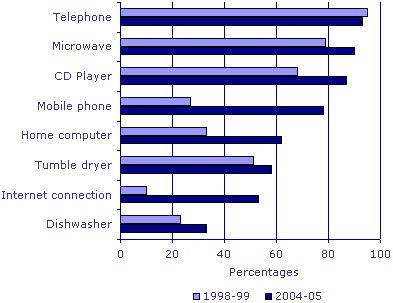 Percentage of households with selected consumer durables, UK
These statistics taken from www.statistics.gov.uk demonstrate the marketability of the concepts proposed. One of the first things i will point out is the rise in ownership of mobile phones. This consumers durable has seen the biggest rise in ownership of all the durables included since 1998. These statistics demonstrate how mainstream ownership of such devices is becoming, which is crucial to the success of the event proposals. If users don't possess the technology to accommodate the proposals then in the short term the event could not be marketable.
In contrast you may also notice that ownership of land line telephones has dropped, this can only be attributed to the rise in mobile telecommunications. Internet connections in houses has seen an equally dramatic rise in ownership, thus supporting the campaign outlines further. With this increase in ownership you would expect an increase in the use of online shopping methods, as well as a general open mindedness to the possibilities other technologies can provide. This open minded approach to technology and acceptance of it as a part of our every day lives is crucial to the success of both the Health Awareness Week campaign concepts.
Friday, 17 November 2006
Heritage Week Event/Concept > SatNav Technologies
I have chosen to research into Sattelite Navigation systems to support the theories discussed within the "Guernsey Heritage Week" event. Satellite navigation systems such as GPS are an integral part of many leading in car navigation systems, which would be integral to promoting the event. It appears that GPS technology is compatible with both in car systems and small devices such as mobile phones which is crucial to the success of the scheme, thus allowing the GPS system to navigate users to a given area, and then allowing their mobile device to direct them to the exact location of the subject of interest.
It seems at current that the only fully functional Global Navigation Satellite Systems (GNSS) is GPS that is controlled by the United States, so in effect any other nation making use of this technology in systems such as in car and small device navigation is a client states of the united states, who have the right to cancel or restrict the usage of services that depend on GPS, not an issue for the proposed campaign (see ideas) but an interesting consideration politically when you consider the future of such technologies. Not surprisingly it seems that other countries or groups of countries, such as the European Union are launching their own GNSS.
"countries without their own satellite navigation systems effectively become client states of those which supply these services." Wikipedia
It seems at current that the only fully functional Global Navigation Satellite Systems (GNSS) is GPS that is controlled by the United States, so in effect any other nation making use of this technology in systems such as in car and small device navigation is a client states of the united states, who have the right to cancel or restrict the usage of services that depend on GPS, not an issue for the proposed campaign (see ideas) but an interesting consideration politically when you consider the future of such technologies. Not surprisingly it seems that other countries or groups of countries, such as the European Union are launching their own GNSS.
"countries without their own satellite navigation systems effectively become client states of those which supply these services." Wikipedia
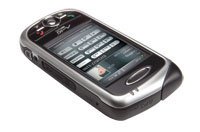
Above: The Mio A701 GPS PDA Phone makes use of GPS technology to provide a mobile navigation system for use on foot or in the car, making that phase of the event possible, it also has Bluetooth connectivity which would enable it to communicate with other devices, such as in car navigation systems mentioned in the concept, this means that it would be viable for the in car nav system to get you as close to the area of interest as possible and then communicate with the mobile phone to lead you to the exact spot. So in conclusion the technologies involved could communicate with one another to accommodate the concept.
Wednesday, 15 November 2006
Background Research > Mobile Browsing Becoming Mainstream
“A global increase in cell phone ownership and a rise in the use of wireless services by people over 35 may lead cell phones to dominate Web browsing, a new study says.”
I personally find it unlikely that a medium dominated by designers who have traditionally been produced to work for the screen or print will adapt so quickly to producing work for wireless phone browsing, this sort of transformation will happen at the rate of the designers as opposed to its demand from consumers. Although the corporate force of commercialism dictates that the medium will inevitably become more prevalent. However I feel this will not be because it is on the whole that useful or desirable to the consumer, more that it will line the pockets of the corporate monkeys that drive it forward. I feel progress should be for the right reasons. What is our society becoming?
“90 percent of households in Japan, South Korea and urban China own cell phones, as do 80 percent of households in Western Europe, 60 percent in Canada and three out of four households in the U.S.”
From this statistic I would grant the fact that there is huge potential for the medium to develop onto the mobile phone, this statistic also makes it very commercially viable, but so far this seems to be the driving force behind its development rather than its practicality.
”27 percent of adults aged 35 to 54 who are living in households with cell phones claim to have browsed the Internet on their phone. Only 21 percent of them did in 2004, according to Wright. Twelve percent of those 55 and older also engage in mobile browsing. “
I would expect from that statistic that this form of commerce is attempting to target the older age bracket as they have more spending power. This is a low percentage and a very vague estimate, how many of those people do this regularly? This also begs the question that how many of those people would actually purchase something using a mobile phone, and does the restrictions of the viewable area lead to infringing customers rights on product misinterpretation. I feel a law suit coming on! It is well known that older customers are more sceptical about online buying, let alone divulging into this on their mobile phones.
I personally find it unlikely that a medium dominated by designers who have traditionally been produced to work for the screen or print will adapt so quickly to producing work for wireless phone browsing, this sort of transformation will happen at the rate of the designers as opposed to its demand from consumers. Although the corporate force of commercialism dictates that the medium will inevitably become more prevalent. However I feel this will not be because it is on the whole that useful or desirable to the consumer, more that it will line the pockets of the corporate monkeys that drive it forward. I feel progress should be for the right reasons. What is our society becoming?
“90 percent of households in Japan, South Korea and urban China own cell phones, as do 80 percent of households in Western Europe, 60 percent in Canada and three out of four households in the U.S.”
From this statistic I would grant the fact that there is huge potential for the medium to develop onto the mobile phone, this statistic also makes it very commercially viable, but so far this seems to be the driving force behind its development rather than its practicality.
”27 percent of adults aged 35 to 54 who are living in households with cell phones claim to have browsed the Internet on their phone. Only 21 percent of them did in 2004, according to Wright. Twelve percent of those 55 and older also engage in mobile browsing. “
I would expect from that statistic that this form of commerce is attempting to target the older age bracket as they have more spending power. This is a low percentage and a very vague estimate, how many of those people do this regularly? This also begs the question that how many of those people would actually purchase something using a mobile phone, and does the restrictions of the viewable area lead to infringing customers rights on product misinterpretation. I feel a law suit coming on! It is well known that older customers are more sceptical about online buying, let alone divulging into this on their mobile phones.
Background Research > Mobile Commercialism
“In its original meaning, is the practices, methods, aims, and spirit of commerce or business. Today, however, it is mainly used as a critical term, referring to the tendency within capitalism to try to turn everything in life into objects and services that are sold for the purpose of generating profit; commercialization, where the value of everything, including such intangible things as happiness, health and beauty become measured in purely commercial, materialistic terms, and where public services are being privatised or outsourced to private companies.”
“The related term "commercialized" is often used in an accusing way, implying that someone, often an artist, has compromised the quality of his work for monetary gain by selling out. It can, for example, be applied to a painter who uses his/her talent to do flattering, expensive portraits to order, an independent music band that signs a contract with a major record label and then changes its music and/or appearance to become more appealing, or a novelist who switches from writing difficult "highbrow" novels to populistic thrillers.”
The topic of commercialisation is particular relevant to that of web based mobile phone services. The article mentions how commercialisation is that act of turning everyday objects into ways of making money, the phone is rapidly becoming one of the most commercially viable tools for corporate businesses. They can target mass numbers of customers anywhere around the globe from anywhere.
Not only do phones offer various ways of leeching your money through useless downloads and ring tones, they are now becoming a platform for viewing the web, opening the customer up to endless advertising and exposure to commercialism.
We are living in a society of endless information and bombardment to visual imagery to tempt us into purchasing products. But essentially what does this mean for our social and cultural structure and how much does the mobile phone contribute to this? I would argue that the mobile phone is fast forgetting its original purpose which essentially is communication. It is turning into a ball and chain of information and advertising that distracts us from our everyday lives, or essentaily is set to become part of it.
The article also mentions that commercialism can be compared to an artist lowering their standard of work for financial gain. I would argue that the same could apply to a designer producing websites for mobile phone screens that are far less useable and have little in the way of graphical finesse compared to that of their 4:3 monitor aspect ratio relatives.
“The related term "commercialized" is often used in an accusing way, implying that someone, often an artist, has compromised the quality of his work for monetary gain by selling out. It can, for example, be applied to a painter who uses his/her talent to do flattering, expensive portraits to order, an independent music band that signs a contract with a major record label and then changes its music and/or appearance to become more appealing, or a novelist who switches from writing difficult "highbrow" novels to populistic thrillers.”
The topic of commercialisation is particular relevant to that of web based mobile phone services. The article mentions how commercialisation is that act of turning everyday objects into ways of making money, the phone is rapidly becoming one of the most commercially viable tools for corporate businesses. They can target mass numbers of customers anywhere around the globe from anywhere.
Not only do phones offer various ways of leeching your money through useless downloads and ring tones, they are now becoming a platform for viewing the web, opening the customer up to endless advertising and exposure to commercialism.
We are living in a society of endless information and bombardment to visual imagery to tempt us into purchasing products. But essentially what does this mean for our social and cultural structure and how much does the mobile phone contribute to this? I would argue that the mobile phone is fast forgetting its original purpose which essentially is communication. It is turning into a ball and chain of information and advertising that distracts us from our everyday lives, or essentaily is set to become part of it.
The article also mentions that commercialism can be compared to an artist lowering their standard of work for financial gain. I would argue that the same could apply to a designer producing websites for mobile phone screens that are far less useable and have little in the way of graphical finesse compared to that of their 4:3 monitor aspect ratio relatives.
Background Research > Web Shifts (Web 1.0 vs. 2.0)
The ways in which we digest content are changing as we speak, mediums such as TV and Radio have been traditionally very structured. The publisher dictates to the consumer what they will consume and most crucially how and when they will consume it. The Web had traditionally been founded on similar values, the webmaster would publish content and it was for users to view. But traditional trends in the Internet are changing, no longer is the user interested in digesting a dictated experience and static content. The user can now contribute to this content and ultimately define their own user experience. Web sites like my space are interesting examples of this shift, users interact with one another and explore various content that has not been provided by one author but provided by a community of people contributing their own content.
Here are a few ways in which the web is shifting from its original roots dubbed web 1.0, to what the web was always hyped up to be web 2.0, an online archive of user defined experiences.
Interpret = Engage
Channels = Platforms Rather than having TV channel with linear broadcasting we have platforms for media to exist on.
Push = Pull Rather than media been dictated and pushed to us we look for it and pull it in.
User = Participant No longer are we just a user, we contribute to the experience using our own content.
Solipsism = Social Networks Groups of people exist online, networking, recommending and defining their own experiences.
Authority = Recommendation No longer are we told what is best to buy, other people talk about and review products to aid our decisions.
Taxonomy = Folksonomy Out with over organisation and tagging, and in with linking and sharing of sites and content
Brand Control = Brand Co-Creation No longer do brands exist alone, they work together to have a more prominent market presence, for example Nike and Ipod.
GUI = Persuasion Paths
Dialogue = Relationship
Here are a few ways in which the web is shifting from its original roots dubbed web 1.0, to what the web was always hyped up to be web 2.0, an online archive of user defined experiences.
Interpret = Engage
Channels = Platforms Rather than having TV channel with linear broadcasting we have platforms for media to exist on.
Push = Pull Rather than media been dictated and pushed to us we look for it and pull it in.
User = Participant No longer are we just a user, we contribute to the experience using our own content.
Solipsism = Social Networks Groups of people exist online, networking, recommending and defining their own experiences.
Authority = Recommendation No longer are we told what is best to buy, other people talk about and review products to aid our decisions.
Taxonomy = Folksonomy Out with over organisation and tagging, and in with linking and sharing of sites and content
Brand Control = Brand Co-Creation No longer do brands exist alone, they work together to have a more prominent market presence, for example Nike and Ipod.
GUI = Persuasion Paths
Dialogue = Relationship
Bacground Research > The Long Tail Effect
"Forget squeezing millions from a few megahits at the top of the charts. The future of entertainment is in the millions of niche markets at the shallow end of the bitstream." - Chris Anderson
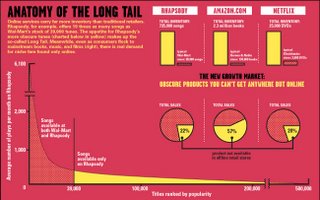
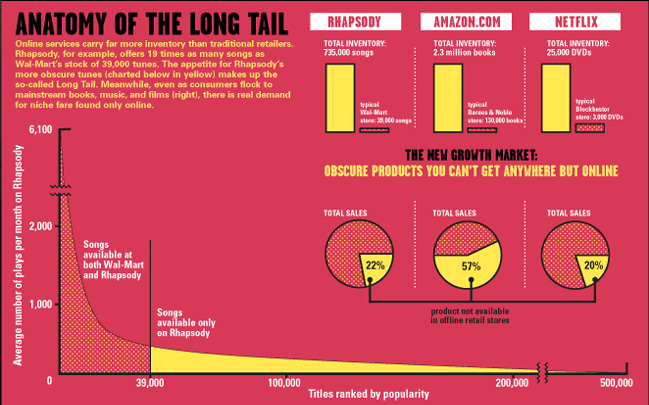
This quote from Chris Anderson starts me off on the topic of the Long Tail Effect, an economic model often used to detail the buying trends of online media, such as video and audio. Imagine if you will a huge HMV store in the middle of London, and imagine how many records they sell. You will notice that a vast majority of sales will come from the top 40 records or albums and the further down the charts you delve the more this buying tails off. Until you reach the records that simply aren't purchased more than once or twice a year, and inevitably get removed from the store. In a sense the tail off in sales limits the length of the "tail". However imagine an online record store, shelf space is not required, recommendations are available, and the diversity of tracks available far outreaches that of the average local record store. Niche markets continue to search out old tracks or B-sides that were forgotten by record stores 20 years earlier, the reason being the customer knows they can dig deeper and find what they are looking for, its all out their for them they just have to find it. These trends create the long tail effect, these niche market tracks continue to find an audience even if its just one or two downloads a month, and why? Because an online store can offer far more content to the customer because they're floor space is not limited, they don't push media to customers in the same way as high street stores, the database of tracks is their for users to search, recommend and define for themselves, and ultimatley will pull in the media we want.
This quote from Chris Anderson starts me off on the topic of the Long Tail Effect, an economic model often used to detail the buying trends of online media, such as video and audio. Imagine if you will a huge HMV store in the middle of London, and imagine how many records they sell. You will notice that a vast majority of sales will come from the top 40 records or albums and the further down the charts you delve the more this buying tails off. Until you reach the records that simply aren't purchased more than once or twice a year, and inevitably get removed from the store. In a sense the tail off in sales limits the length of the "tail". However imagine an online record store, shelf space is not required, recommendations are available, and the diversity of tracks available far outreaches that of the average local record store. Niche markets continue to search out old tracks or B-sides that were forgotten by record stores 20 years earlier, the reason being the customer knows they can dig deeper and find what they are looking for, its all out their for them they just have to find it. These trends create the long tail effect, these niche market tracks continue to find an audience even if its just one or two downloads a month, and why? Because an online store can offer far more content to the customer because they're floor space is not limited, they don't push media to customers in the same way as high street stores, the database of tracks is their for users to search, recommend and define for themselves, and ultimatley will pull in the media we want.
Tuesday, 14 November 2006
Background Research > Be Bold and Simple?
“The problems you face are further complicated by varying lighting conditions. Mobile phones are used everywhere; indoors, outdoors, at night, and in bright sunlight. For mobile Flash content in general and animation in particular, this means you have to be bold, don't focus on small details.”
These design considerations are very interesting, and something I had not considered until reading this article by Adobe. It appears that small detail is easily missed on a mobile phone screen due to varying lighting factors and the movement of the screen while using it. It had also occurred to me while using my phone to play an online game of brick breaker, that focusing on such vibrant colours on a small screen that is moving constantly in and out of focus is very bad for your eyes. Could it be that mobile phone companies or M-Commerce businesses could be accused of damaging the health of their customers? In America anything is possible!
“Users most likely will not even notice subtle smooth colour transitions, unless they just can't tell anymore what they are looking at. Pump up the contrast. Even if that bothers your colour-sensitive eyes, your users will thank you for it.”
If users require high contrast to view websites and imagery effectively then this may conflict with artists and designers who feel that their work is been misinterpreted by the restrictions of the mobile phone screen. It think the user needs to realise that the internet on mobile phones is useful for informational based things like the weather or downloads of music etc, but as a platform for browsing it constrains the mediums that’s may be presented on it to a high degree, this may have implications when browsing sites such as Amazon and eBay with purchasing in mind.
“For animations, focus on close-ups, while avoiding panoramic views and pans (see Figure 3). A lot of detail will be lost on the small screen, and as great as your animation may look on your desktop computer, if it can't be seen on the mobile phone the user will not appreciate it.”

Figure 3: Close-ups immerse you in the content.
It seems from comments like this that simplicity and bold colours are the what designers must use to translate visual content to the audience effectively in varying conditions of mobile phone use.
“Slick motion graphics in Flash often require high frame rates to look smooth. You can see people using 30, 60, or even 100 frames per second (fps) to achieve the appearance of smooth motion with tweens. Try that on a mobile phone, and chances are you will only see something stuttering across the screen, which is anything but a pleasant experience.”
This demonstrates another restriction of mobile phones in displaying a media type that is now prevalent to the web and will be featured on numerous sites that users may navigate using their phones. Mobile phones may also have restricted memory or connection speeds, because at the end of the day they have nothing on the processing power of even the most average PC or Mac. So this means that special consideration should be taken by designers when considering the use of large files such as video or graphical elemnts, are they necesary to convey the content?
“At this point you may wonder, "Is it really worth all the trouble?" The answer is a resounding "Yes." If you're not trying to squeeze a two-minute-long animation onto a phone, you'll probably not even face half the troubles that we went through. For us, it was a challenge we couldn't refuse, and we succeeded. And I hope that what we learned will save you some headaches and trouble as well.”
It seems that this designer relished the challenge of producing for a new media platform, and on the basis of succeeding they feel it was worth the effort, however when you think of what has actually been produced and could look so much better then you have to ask the question, are the restrictions this media platform poses to designers work really worth it? In todays market, the resounding answer has to be yes, imagine from a business perspective the advantages of been able to push media out to users on different platforms, at any time of the day, in any place.
These design considerations are very interesting, and something I had not considered until reading this article by Adobe. It appears that small detail is easily missed on a mobile phone screen due to varying lighting factors and the movement of the screen while using it. It had also occurred to me while using my phone to play an online game of brick breaker, that focusing on such vibrant colours on a small screen that is moving constantly in and out of focus is very bad for your eyes. Could it be that mobile phone companies or M-Commerce businesses could be accused of damaging the health of their customers? In America anything is possible!
“Users most likely will not even notice subtle smooth colour transitions, unless they just can't tell anymore what they are looking at. Pump up the contrast. Even if that bothers your colour-sensitive eyes, your users will thank you for it.”
If users require high contrast to view websites and imagery effectively then this may conflict with artists and designers who feel that their work is been misinterpreted by the restrictions of the mobile phone screen. It think the user needs to realise that the internet on mobile phones is useful for informational based things like the weather or downloads of music etc, but as a platform for browsing it constrains the mediums that’s may be presented on it to a high degree, this may have implications when browsing sites such as Amazon and eBay with purchasing in mind.
“For animations, focus on close-ups, while avoiding panoramic views and pans (see Figure 3). A lot of detail will be lost on the small screen, and as great as your animation may look on your desktop computer, if it can't be seen on the mobile phone the user will not appreciate it.”

Figure 3: Close-ups immerse you in the content.
It seems from comments like this that simplicity and bold colours are the what designers must use to translate visual content to the audience effectively in varying conditions of mobile phone use.
“Slick motion graphics in Flash often require high frame rates to look smooth. You can see people using 30, 60, or even 100 frames per second (fps) to achieve the appearance of smooth motion with tweens. Try that on a mobile phone, and chances are you will only see something stuttering across the screen, which is anything but a pleasant experience.”
This demonstrates another restriction of mobile phones in displaying a media type that is now prevalent to the web and will be featured on numerous sites that users may navigate using their phones. Mobile phones may also have restricted memory or connection speeds, because at the end of the day they have nothing on the processing power of even the most average PC or Mac. So this means that special consideration should be taken by designers when considering the use of large files such as video or graphical elemnts, are they necesary to convey the content?
“At this point you may wonder, "Is it really worth all the trouble?" The answer is a resounding "Yes." If you're not trying to squeeze a two-minute-long animation onto a phone, you'll probably not even face half the troubles that we went through. For us, it was a challenge we couldn't refuse, and we succeeded. And I hope that what we learned will save you some headaches and trouble as well.”
It seems that this designer relished the challenge of producing for a new media platform, and on the basis of succeeding they feel it was worth the effort, however when you think of what has actually been produced and could look so much better then you have to ask the question, are the restrictions this media platform poses to designers work really worth it? In todays market, the resounding answer has to be yes, imagine from a business perspective the advantages of been able to push media out to users on different platforms, at any time of the day, in any place.
Background Research > Creating Experiences for the Small Screeen
“Before you get started, you have to realize how small the screen you're targeting really is, not just in terms of resolution, but also in terms of physical size. Take a business card, and cut it in half that's about the size you are designing for.”
This shows how the designer must adapt to design with the small screen in mind. If the mobile phone is ever going to be a useful way to display media types, especially visual ones, special consideration must be taken with design. Rather than just displaying normal sites designed for monitor aspect ratios
“In technical terms, the display on a Symbian Series 60 phone is 176 x 208 pixels, which is only slightly bigger than the screen size of other Flash Lite–enabled phones. Of course, if your application is not running in full-screen mode, you have even less room to work with.”
This shows how small an area designers are forced to work with if the are designing media or websites specifically for mobile phones. The complications of small screen sizes do not end their. Screen sizes on mobile phones are not a standard size or aspect ratio, this makes designing for them an impossibility. What may look fine designed for one screen size and ratio may look terrible for another. Is some standardisation needed? I think to some extent yes, however this will restrict the design of phone dramatically. But I feel that this needed so that designers are clear what they are working for.
“Note also that mobile phones use a vertical aspect ratio. Desktop content is often created with a TV-like 4:3 or a cinematic 16:9 aspect ratio. On a small device screen, you don't want to waste a pixel, so you really have to think through the design of your animation to make the most of the limited space.”
This again reiterates the constraints of mobile phone screen sizes and their lack of standard aspect ratio compared to TV’s and Monitors.
“Don't let the resolution of the device fool you; it is actually pretty decent. However, each pixel is smaller than on your desktop monitor, because the dots-per-inch (DPI) ratio is higher. You can easily verify that by holding the phone next to a Flash movie of the same size on your desktop monitor. Depending on your monitor, the phone display will have only some 70% of the screen real estate.”
This shows how the designer must adapt to design with the small screen in mind. If the mobile phone is ever going to be a useful way to display media types, especially visual ones, special consideration must be taken with design. Rather than just displaying normal sites designed for monitor aspect ratios
“In technical terms, the display on a Symbian Series 60 phone is 176 x 208 pixels, which is only slightly bigger than the screen size of other Flash Lite–enabled phones. Of course, if your application is not running in full-screen mode, you have even less room to work with.”
This shows how small an area designers are forced to work with if the are designing media or websites specifically for mobile phones. The complications of small screen sizes do not end their. Screen sizes on mobile phones are not a standard size or aspect ratio, this makes designing for them an impossibility. What may look fine designed for one screen size and ratio may look terrible for another. Is some standardisation needed? I think to some extent yes, however this will restrict the design of phone dramatically. But I feel that this needed so that designers are clear what they are working for.
“Note also that mobile phones use a vertical aspect ratio. Desktop content is often created with a TV-like 4:3 or a cinematic 16:9 aspect ratio. On a small device screen, you don't want to waste a pixel, so you really have to think through the design of your animation to make the most of the limited space.”
This again reiterates the constraints of mobile phone screen sizes and their lack of standard aspect ratio compared to TV’s and Monitors.
“Don't let the resolution of the device fool you; it is actually pretty decent. However, each pixel is smaller than on your desktop monitor, because the dots-per-inch (DPI) ratio is higher. You can easily verify that by holding the phone next to a Flash movie of the same size on your desktop monitor. Depending on your monitor, the phone display will have only some 70% of the screen real estate.”
Background Research > Aspect Ratios
“For many artists, however, aspect ratio is, and in their view, should be, determined not by the constraints of the technology or medium, but by the content or the story. Indeed, as long ago as the early 20th century, film directors such as D.W. Griffith, one of the early giants in film, would sometimes change the picture aspect ratio within the film. In "Intolerance", for example, a single shot where a character falls from a high wall has the sides of the vista greatly cropped to enhance the dramatic height of the fall. Today, Directors of Photography often compose the shot to keep the essential subjects in the sweet spot of the frame, regardless of final view aspect ratio. And, sometimes, frame a shot with foreground objects obscuring frame edges to, in effect, change the screen aspect ratio using in-shot mattes.”
This is a very interesting extract on aspect ratios from Wikipedia. The first lines mention that artists feel that rather than designing for a certain aspect ratios, that aspect ratios should be adaptable to fit the constraints of the work. Mobile phones however will contradict this to a high extent, altering aspect ratios and work to fit the constraints of their varying screen sizes. Surely designers should break free from the concept that design Is purely a monitor based medium, in today’s multimedia world with increasing platforms for browsing, designers must think of the big picture, with more and more users using alternate means to access web content.
This is a very interesting extract on aspect ratios from Wikipedia. The first lines mention that artists feel that rather than designing for a certain aspect ratios, that aspect ratios should be adaptable to fit the constraints of the work. Mobile phones however will contradict this to a high extent, altering aspect ratios and work to fit the constraints of their varying screen sizes. Surely designers should break free from the concept that design Is purely a monitor based medium, in today’s multimedia world with increasing platforms for browsing, designers must think of the big picture, with more and more users using alternate means to access web content.
Subscribe to:
Posts (Atom)